
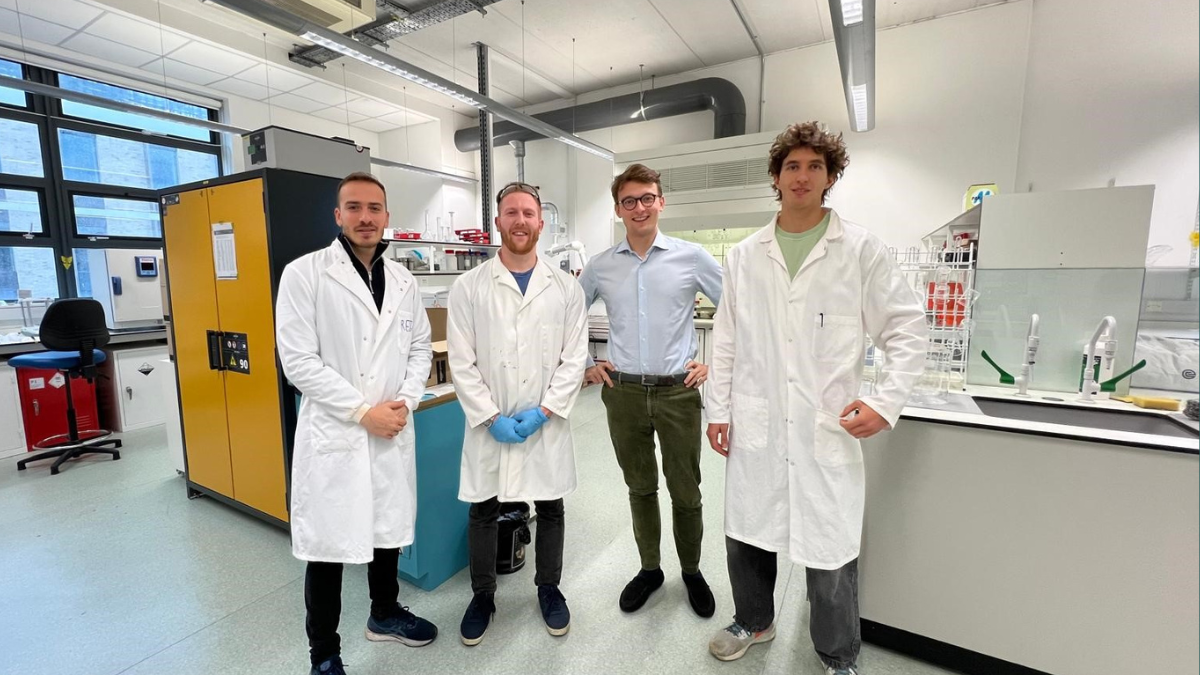
Based in the AgileLab at Begbroke Science Park, A&B Smart Materials creates biodegradable alternatives to fossil-based synthetic superabsorbent polymers used in hygiene products, agriculture and packaging. The company recently received funding from the Henry Royce Institute to advance its technology. We spoke with the team about what this support means for their next stage of growth.
Can you tell us a bit about the funding you received recently and what it will help A&B Smart Materials achieve?
“We were recently awarded funding from the Henry Royce Institute Industrial Collaboration Programme for our project ‘Biobased Superabsorbent Polymers for a Cleaner Future’, in partnership with the University of Warwick and ReactWise.
“Our work focuses on developing biobased and biodegradable superabsorbent polymers (SAPs), advanced materials capable of absorbing and retaining hundreds of times their own weight in water. SAPs are widely used in hygiene products such as nappies, sanitary pads, and cosmetics, as well as in agriculture, where they improve soil moisture retention and reduce irrigation needs.
“Today, nearly all SAPs are made from non-biodegradable, petroleum-based materials. Our goal is to create sustainable alternatives derived from natural feedstocks that deliver the same performance while breaking down safely in the environment.
“The funding will help us:
- Optimise our biobased SAP formulations and make key steps towards commercialisation, bringing performance closer to that of conventional synthetic materials.
- Scale up production from gram to kilogram quantities in preparation for commercial testing.
“This work comes at a pivotal time, as the EU is introducing a ban on synthetic SAPs used in soils by 2028, creating strong demand for sustainable alternatives.”
How did it feel to find out that your work had been recognised and supported in this way?
“It was incredibly rewarding to see our technology recognised by one of the UK’s leading materials research institutions. The Royce Institute’s endorsement is a major validation of our scientific approach and commercial potential. For a young company like ours, it confirms that our work addressing global sustainability and plastic pollution challenges is both timely and impactful.”
What impact do you think this funding will have on your future projects or growth plans?
“This grant is crucial in allowing us to scale our technology from gram-scale laboratory experiments to kilogram-scale production, a key step toward demonstrating the practicality and reproducibility of our materials at larger volumes. It enables us to strengthen our core technology platform, refine our formulations, and increase the maturity of our process as we move closer to commercialisation.
“It also provides the resources needed to validate our materials with industrial partners and to assess their performance and sustainability through rigorous external testing. “Together, these activities will help position A&B Smart Materials for future growth and larger-scale collaboration opportunities.”
How has being based at the AgileLab and Begbroke helped you reach this milestone?
“Being based at the AgileLab at Oxford’s Begbroke Science Park has been instrumental to our success. The access to high-quality lab infrastructure, the vibrant community of scientists and entrepreneurs, and the close connection to the University of Oxford have allowed us to innovate quickly and effectively. Begbroke provides exactly the type of ecosystem where early-stage materials science companies can thrive.”
